A 20 minute strength workout for busy holiday weeks
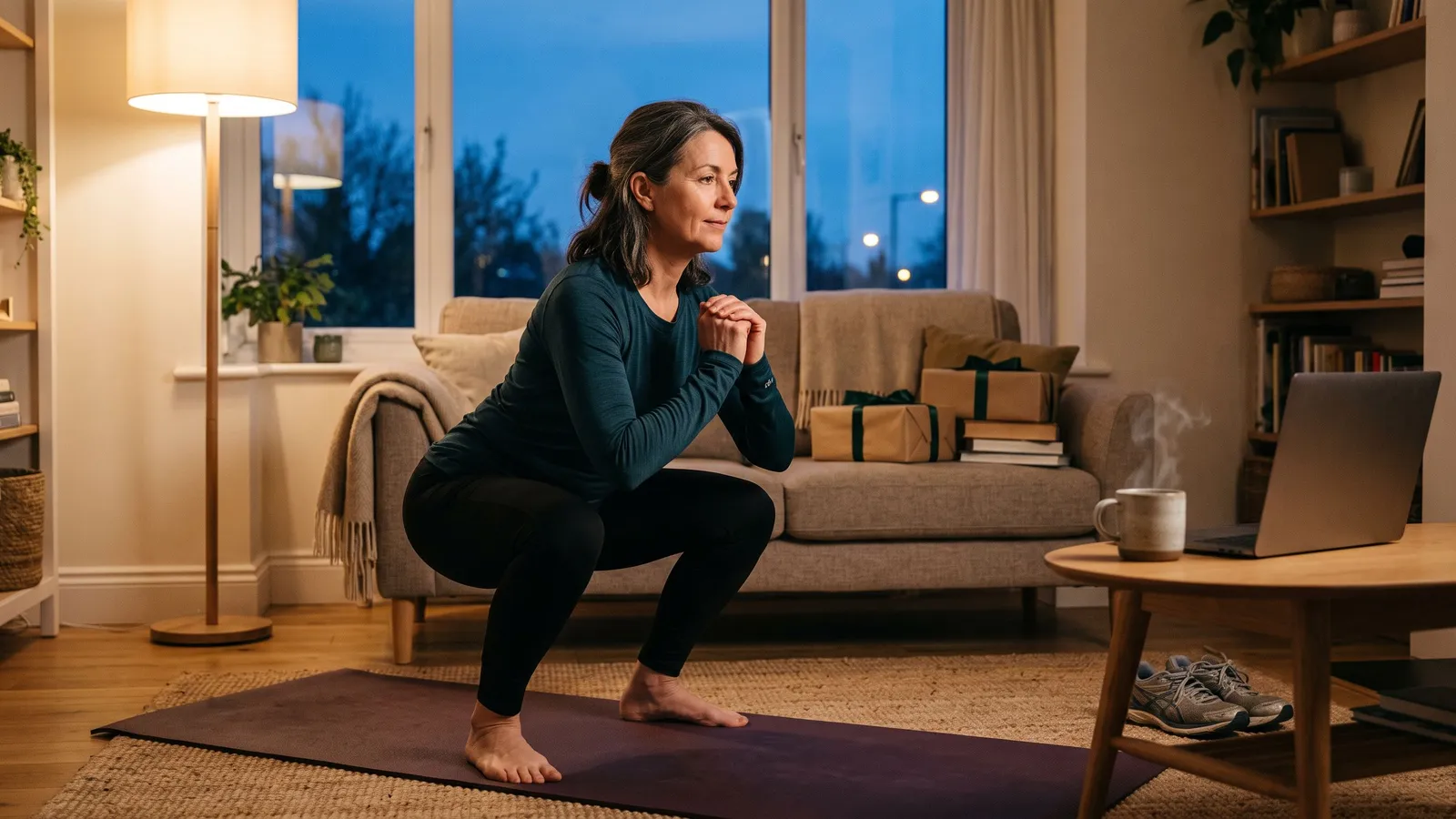
A 20 minute strength workout done two or three times a week is enough to keep your muscles working through the holidays, as long as it hits your whole body and you actually do it. Below is one no-equipment routine you can follow in your living room or a hotel room, with easier and harder options for every move. Then: how to fit it into a week of travel and hosting.
Does a 20 minute strength workout really count?
Yes. The CDC's guidance for adults asks for muscle-strengthening activities on 2 or more days a week that work all major muscle groups: legs, hips, back, abdomen, chest, shoulders and arms. It sets no minimum session length.
The federal Physical Activity Guidelines from HHS say the same thing in plain words: adults need muscle-strengthening activity, like lifting weights or doing push-ups, at least 2 days each week. They also note that any amount of physical activity has some health benefits. On a busy week, the short session is the one that gets done.
For women in their 40s to 60s, strength is easier to keep than to rebuild, and the weeks before New Year are when routines slip.
Next question: What does a full strength training plan with a coach include?
The 20 minute strength workout, written out
All you need is a mat or carpet, a sturdy chair and a wall. Work at a pace where the last few reps feel hard but your form stays clean. If anything causes sharp pain, stop that move. If you have a medical condition, talk to your doctor before starting a new program.
Warm-up (4 minutes)
- March in place, swinging your arms: 1 minute
- Arm circles, forward and back: 30 seconds each way
- Hip hinges (hands on hips, push your hips back, stand tall): 10 slow reps
- Bodyweight good mornings into a small squat: 10 reps
Main circuit (13 minutes)
Do each move for 40 seconds, rest 20 seconds, then go to the next. Six moves make one round of 6 minutes. Rest 1 minute, then do a second round.
- Chair squat. Sit back until you lightly touch the chair, then stand up driving through your heels. Legs and hips.
- Incline push-up. Hands on a kitchen counter or the back of a sofa, body in a straight line, lower your chest and press away. Chest, shoulders and arms.
- Reverse lunge. Step one foot back, lower both knees, return. Alternate legs. Hold the chair for balance if you need it.
- Prone W raise. Lie face down, elbows bent like a W, squeeze your shoulder blades and lift your arms and chest an inch or two. Upper back.
- Glute bridge. Lie on your back, knees bent, press through your heels and lift your hips until your body is a straight line from knees to shoulders. Hips and lower back.
- Dead bug. On your back, arms up, knees over hips. Slowly lower the opposite arm and leg, keep your lower back on the floor, return and switch. Abdomen.
Cool-down (3 minutes)
- Standing hamstring stretch, one leg forward on the heel: 30 seconds each side
- Hip flexor stretch in a half kneel: 30 seconds each side
- Doorway chest stretch: 30 seconds
- Slow breathing, lying or seated: 30 seconds
Next question: How does a coach build a no-equipment workout around my home?
Easier and harder options for every move
The right version is the one where you can finish the 40 seconds with good form and feel like you had two or three reps left. Too easy, move up. Form falling apart, move down.
- Chair squat. Easier: sit fully, then stand, using your hands on your thighs. Harder: hover above the chair for a 2-second pause, or hold a full water jug at your chest.
- Incline push-up. Easier: push-up against a wall. Harder: lower the surface to a sturdy chair seat, then the floor on your knees.
- Reverse lunge. Easier: a split squat with both feet staying in place and one hand on the chair. Harder: slow the lowering to 3 seconds, or lift the front foot onto a low step.
- Prone W raise. Easier: do it standing with your back against a wall, sliding your arms up and down. Harder: hold each lift for 3 seconds.
- Glute bridge. Easier: smaller range, hands pressing into the floor. Harder: single-leg bridge, switching legs halfway.
- Dead bug. Easier: move only the legs, one at a time, arms resting. Harder: extend arm and leg fully and slow everything down.
Beginners can do one round for the first week or two, then add the second.
Next question: What does online training look like if I am a complete beginner?
How to fit two or three sessions into a holiday week
The workout is the easy part. The hard part is the calendar. Here is what works for most people I coach in this stretch.
- Pick the days on Sunday night. Two fixed days, say Monday and Thursday, and one optional day.
- Go early. Evenings fill up and it is dark by 5. A 7 AM session happens before the day can take it.
- Plan around the big days. On a Thanksgiving week, train Monday and Wednesday, then take a walk after the meal on Thursday.
- Use the short version when you must. One round of the circuit plus the warm-up is about 12 minutes. That still counts as a strength day, and it keeps the habit alive.
- Do not double up to catch up. If you miss a day, just do the next one.
Next question: How do busy people keep a training schedule when work and family run long?
What to do when you are traveling
Every move works in a hotel room or a guest bedroom. A few adjustments help:
- Use the edge of the bed for squats and a desk or dresser for incline push-ups.
- Lay a towel down for the floor moves if there is no mat.
- Train the morning before you leave and the first morning you arrive.
- Keep your usual time if you can. A familiar slot is easier to keep.
Next question: Can I keep training with the same coach while I travel?
Why a 7 AM session with a real coach makes it happen
Fitness apps and AI chatbots can write a perfectly reasonable 20 minute routine in seconds. They are cheap, always available and decent at programming. What they cannot do is notice that your knees cave in on the third squat, or that you are moving slower than usual because you slept badly after hosting fourteen people.
A live coach on video sees your form and corrects it on the spot. They swap a lunge for a split squat when your hip is cranky, remember that you are flying to your sister's on Wednesday, and plan the week around it. And there is the simplest part: a person is expecting you at 7:00. A notification is easy to skip. A coach who is already waiting is not.
One timing note for this time of year: if you have a calendar-year FSA, unused money usually has to be spent by the end of the plan year, though HealthCare.gov explains that some employers offer either a grace period of up to 2½ months or a limited carryover. Our FSA deadline calculator shows how much time you have left, and our HSA and FSA page explains when training qualifies.
Next question: How does live online personal training work session to session?
How HipTrain can help
HipTrain pairs you with a certified coach for live 1-on-1 video sessions on your phone or laptop, from $14 per session. Your coach watches your form, scales each move to your body and your week, and keeps the time slot you choose, including 7 AM. Many of our clients are women over 50 training at home with no equipment. Book a free trial session and do your first 20 minute strength workout with a real person on the other side of the screen.
FAQ
Is a 20 minute strength workout enough to build muscle?
For most beginners and people returning to exercise, it can be, if it works all the major muscle groups, is challenging by the last few reps and is done at least twice a week. As it gets easier, move to the harder options so the work keeps progressing.
Can I do this workout every day?
Leave a day between strength sessions so your muscles recover. Walk or stretch on the days in between.
Do I need weights for a strength workout at home?
No. Bodyweight moves, a chair and a wall are enough to start. When the harder options stop feeling hard, a resistance band or a pair of light dumbbells is the next step.
What if I miss a week over the holidays?
Start again with one round of the circuit and build back to two. A missed week is normal in December.