AI fitness app vs personal trainer: which is right for you?
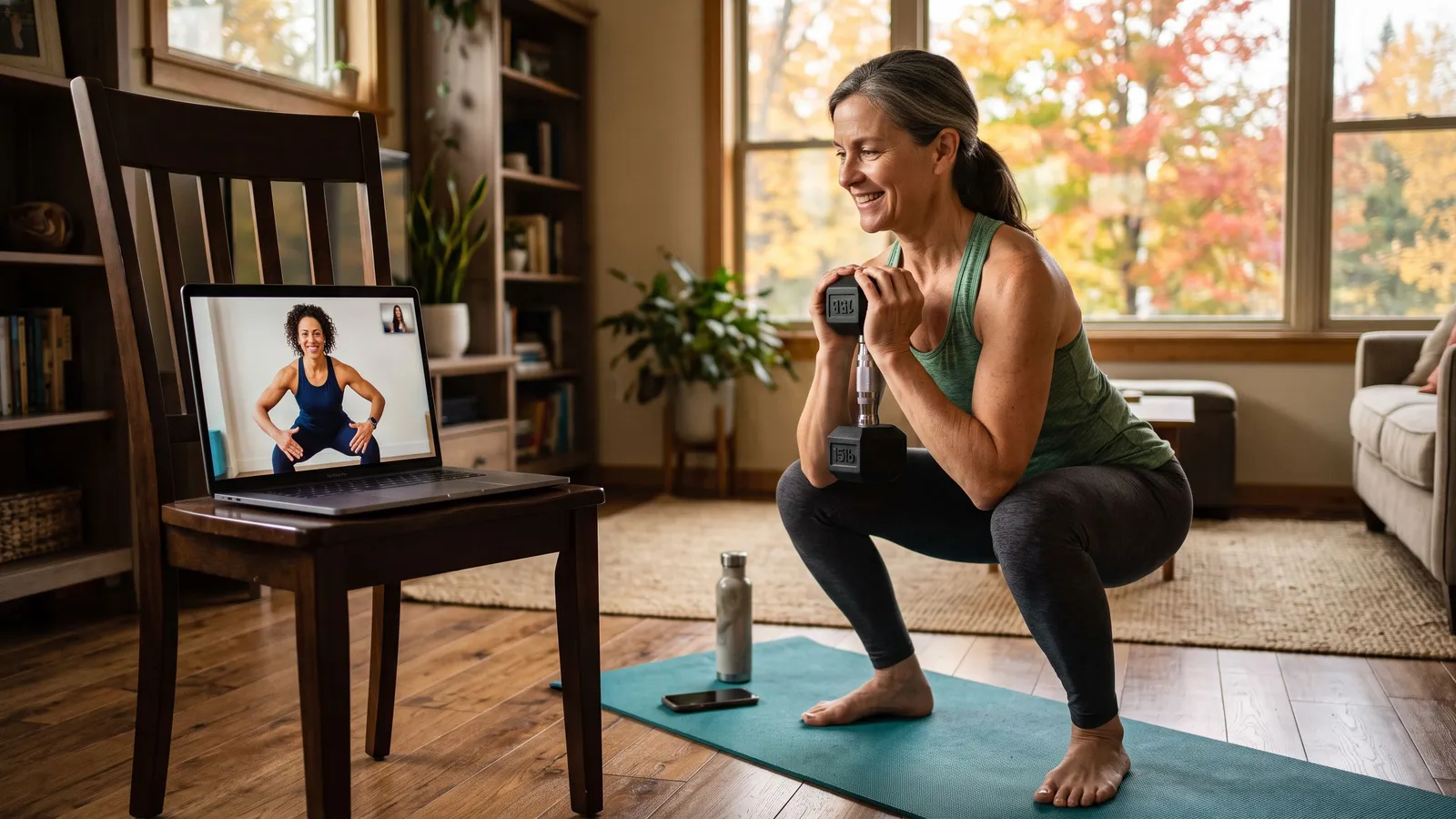
If you are weighing an AI fitness app vs personal trainer, here is the short answer: the app wins on price and availability, and a live human wins on everything that requires actually seeing you. The real question is whether you need a plan or need someone watching to make sure the plan happens. What follows is a fair comparison from a coach who has trained hundreds of people over video, with the research, the costs, and a decision guide.
What AI fitness apps and chatbots do well
Let's give the apps their due. ChatGPT will write you a four-week plan in ten seconds, for free, at 11 p.m. on a Sunday. Pew Research Center found that 34% of U.S. adults had used ChatGPT by mid-2025, including a quarter of adults aged 50 to 64.
The programming is often decent for general questions. A 2026 study in the Journal of Sports Science and Medicine had nine certified trainers answer their most common client questions, then put the same questions to an earlier version of ChatGPT. Graders rated the answers blind, and ChatGPT scored higher on six of the nine. The authors call the results exploratory, but they match what I see: for "how many sets should a beginner do," the bot's answer is usually fine.
Apps are also good at data. Wearables and mobile exercise apps hold the top two spots in ACSM's fitness trends list for 2027, because they count, log, and remind well. HipTrain uses technology too: sessions run over video, and you chat with your coach and reschedule in the app. The technology is not the problem.
AI fitness app vs personal trainer: what only a live human can do
Here is where the two stop being comparable. An app has never seen you move, so every plan it writes is a guess about a body it cannot observe. A live trainer, in the room or on a video call, does five things no app can do yet:
- Sees your form in real time. When your knees drift inward on a squat, I say "stop, reset" before rep three, not after a week of sore hips.
- Adjusts mid-set. If rep six looks shaky, the set ends at six. If you look strong, we add a little. A plan on a screen decided your reps last night.
- Notices pain and fatigue. A coach reads your face and your breathing. When TIME writer Jennifer Heimlich followed a ChatGPT strength plan for nearly a month, its advice about her sore thigh was vague. A running coach she interviewed said telling pain from discomfort takes a list of questions, which Heimlich noted AI coaches do not ask the way a human would.
- Knows your week. Your coach remembers that you traveled, that your knee was cranky in September, and that you hate burpees.
- Expects you at a set time. Someone is waiting for you at 7:00 a.m. Tuesday. That one fact does more for consistency than any streak badge.
A trainer also catches bad output. In that same TIME piece, the chatbot's marathon plan suggested running a full marathon a week before the end of the plan. If you do not know what good looks like, you cannot check the machine.
What the research says about accountability
Most of us do not have an information problem. We have a doing problem. In 2020, only 24.2% of U.S. adults met the federal guidelines for both aerobic and muscle-strengthening activity, according to the CDC. Knowing the guidelines did not move the number.
Supervision does. A 2017 systematic review in Sports Medicine pooled 11 studies of adults 65 and older and found that supervised balance and resistance training improved strength and balance more than unsupervised training, with the biggest gap when the unsupervised group had no supervised sessions at all. The authors recommend two of three weekly sessions be supervised, and note the number of studies was small.
It is not only older adults. A 2023 trial in the Journal of Sports Sciences had 36 experienced lifters run the same eight-week program, half with a coach present and half alone. The supervised group gained more muscle and more squat strength, and the authors concluded that supervision also improved adherence. Same plan, but a person was watching.
A decision guide: who should use which
Pick an app or a chatbot plan if most of these are true:
- You have trained consistently before and know what good form feels like.
- You have no current pain, no joint history, and no condition your doctor wants you to be careful with.
- You are self-motivated and your budget is close to zero.
Pick a live personal trainer if most of these are true:
- You are new to strength training, or coming back after years away.
- You are over 50 and strength and balance matter to you.
- You have a knee, shoulder, back, or hip that needs watching.
- You have started and stopped more than once, and want someone to notice when you show up.
The hybrid most people land on: a live coach once or twice a week for form, progression, and accountability; a chatbot for quick questions between sessions; and a watch for steps and sleep. The coach owns the plan.
If you are unsure, run a two-week test:
- Week one: follow a chatbot plan. Count the sessions you actually finished.
- Week two: book a free live session (ours is at /start).
- Compare how your body felt and which week you would repeat.
It is late October, the days are shorter, and most routines slip now and stay slipped through the holidays. A set appointment with a person is the easiest way I know to not stop in November.
What live 1-on-1 video training costs compared with in-person
In-person training in the U.S. runs about $40 to $100 an hour, with a national average of $55, according to Thumbtack. Home visits and private studios may cost more, and session packages often come with a discount. At the average rate, one hour a week is about $238 a month, before travel time.
Live video training costs less because nobody travels. HipTrain starts at $14 a session, with plans from $59.49 to $319.99 a month depending on session length and weekly frequency. Our personal trainer cost guide walks through the monthly math, and our online vs in-person comparison is honest about what a trainer in the room can do that a camera cannot.
App-based coaching sits in between. Future and Trainwell pair you with a real coach, but most coaching happens through an in-app plan plus texts or calls, not a live workout. See our HipTrain vs Future and HipTrain vs Trainwell pages for the differences and their published prices.
One year-end note: if you have flexible spending account money that expires in December, personal training can qualify when it treats a condition your doctor has diagnosed. HipTrain is HSA and FSA eligible, and this page explains how reimbursement works.
How HipTrain helps
HipTrain is live 1-on-1 personal training over video with a certified coach who sees you, corrects your form as you move, and expects you at the time you booked. You keep the same coach every session and train from your living room with no gym and no equipment. Members have rated us 5 stars on Google. Your first session is free with no credit card needed, so book your free trial session and see what a person watching changes.
FAQ
Can ChatGPT write a good workout plan?
For a healthy, experienced person it can write a reasonable generic plan, and a 2026 study found it answered common training questions as well as or better than a small group of certified trainers. It cannot watch you perform the plan, so it cannot catch form problems, adjust to how you feel that day, or tell normal soreness from the start of an injury.
Is an AI fitness coach safe for beginners or people over 50?
It can be, if you stick to low-risk movements and talk to your doctor first when you have a condition. The research in older adults favors having a person watch at least some of your sessions. If you have a joint history or are starting from scratch, a live coach is the lower-risk choice.
Is online personal training as effective as in-person?
For most people, yes, as long as the sessions are live. A coach on video can see your form, cue you in real time, and hold you to a schedule. Video cannot physically adjust your position or spot a heavy barbell lift, so if you need that, an in-person trainer is the better fit.
What is the best way to combine an app with a trainer?
Let the coach own the plan and the progression, and use the app for logging, reminders, and quick answers between sessions. Tell your coach what the app says. A good trainer will use that data, and will tell you when to ignore it.