Exercise after stopping GLP-1: how to keep your progress
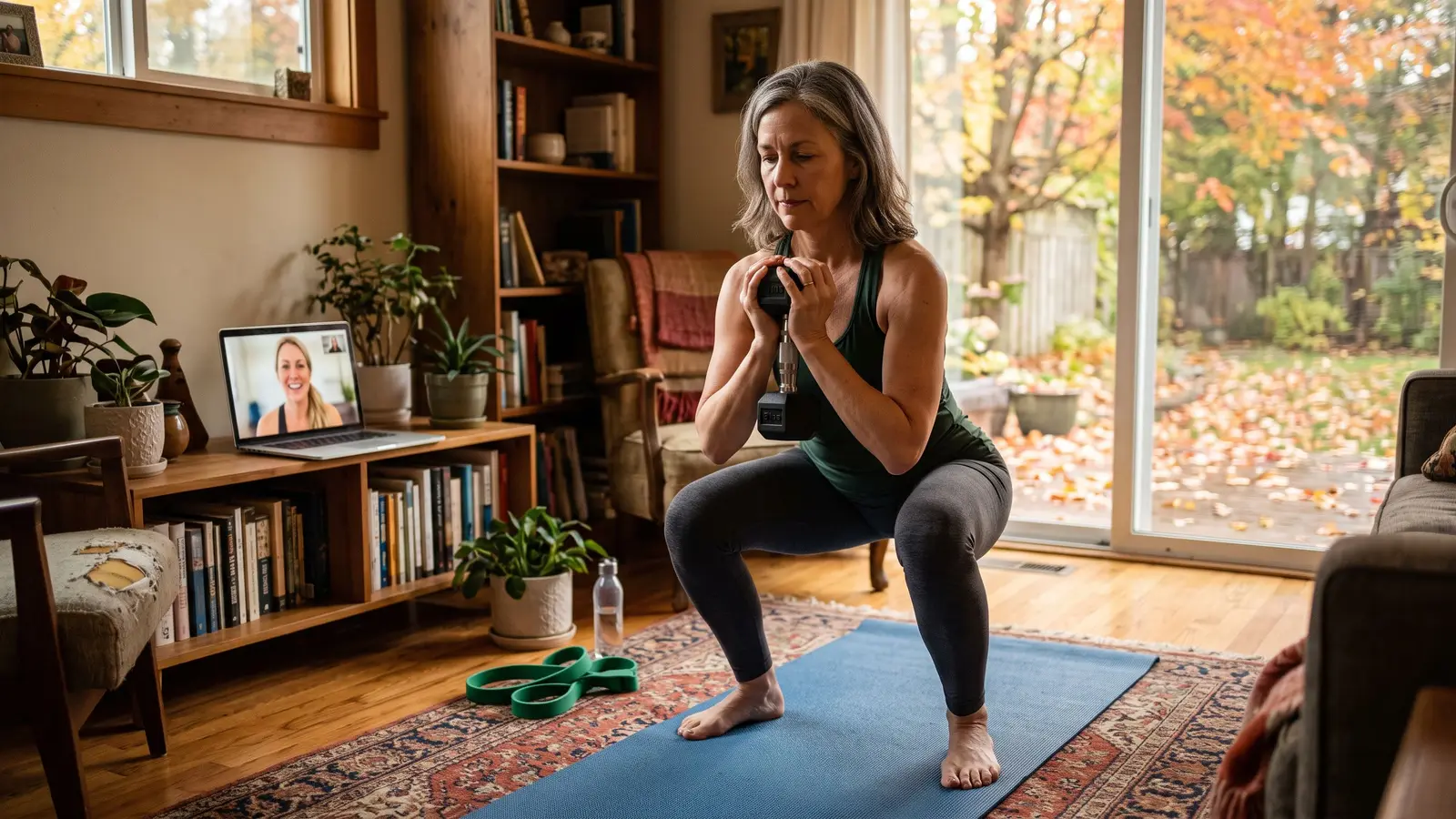
If you are stopping or tapering a GLP-1 medication like Ozempic, Wegovy or Zepbound, the most useful exercise after stopping GLP-1 treatment is regular strength training two to three times a week, plus daily walking you can actually keep up. Muscle is what you want to protect, and habits are what carry you once the medication is no longer doing part of the work. Make every decision about the medication itself with your prescriber; this guide covers only the exercise side.
It is written by coaches who train people over live video every day, many of them in exactly this spot. No shame, no scare tactics. Just a plan.
What the research says about coming off a GLP-1
Weight regain after stopping is common, and it is not a personal failing. It is what the studies show happens on average, which is why planning for it matters.
- STEP 1 extension. In a follow-up of the STEP 1 semaglutide trial, people lost an average of 17.3% of their body weight over 68 weeks. One year after treatment stopped, they had regained 11.6 percentage points, about two-thirds of what they lost (Wilding et al., Diabetes, Obesity and Metabolism, 2022). Worth noting: the trial's lifestyle program stopped at the same time as the drug.
- A large 2026 review. A BMJ review of 37 studies and 9,341 people found an average regain of about 0.4 kg per month after weight management medications ended, and faster regain than after diet and behavior programs ended (BMJ, 2026).
These are averages, not your forecast. Some people keep more off, some less. Your prescriber may suggest tapering, a lower dose or staying on longer. That is their call with you, not ours.
What exercise can do is give you something solid that does not stop when the prescription does.
Next question: How should I strength train while I am still on a GLP-1?
Why strength training is the anchor
When you lose weight quickly, some of it can be muscle. Muscle keeps you strong enough to climb stairs, carry groceries and get up off the floor, and it is much easier to keep than to rebuild. Lifting tells your body that muscle is still needed.
There is also encouraging research on exercise after a GLP-1 ends. In a Copenhagen trial, adults who had lost weight on a low-calorie diet spent a year on supervised exercise, the GLP-1 liraglutide, both, or placebo. One year after all treatment stopped, regain was 6.0 kg larger in the people who had taken liraglutide alone than in those who had done supervised exercise. The authors concluded that adding supervised exercise to medication seemed to improve weight maintenance after treatment ended (Jensen et al., eClinicalMedicine, 2024).
It was one trial, with an older GLP-1 and a modest number of people, so treat it as a promising signal rather than a promise. But the word that stands out is supervised. Someone was running those sessions.
Next question: What does a live strength training session look like?
A weekly plan for exercise after stopping GLP-1
The CDC's baseline for adults is at least 150 minutes a week of moderate activity, like brisk walking, plus muscle-strengthening work on at least 2 days that covers the legs, hips, back, abdomen, chest, shoulders and arms (CDC). Here is a simple way to build a week around that.
- Monday: full-body strength, 30 to 40 minutes. Squats to a chair, a hip hinge or bridge, a push (wall or counter push-ups), a pull (band rows), and a carry or plank.
- Tuesday: walk 20 to 30 minutes. Brisk enough that talking takes a little effort.
- Wednesday: full-body strength. Same moves. Add a rep, a few seconds of slower lowering, or slightly heavier weight if last time felt easy.
- Thursday: walk, plus 10 minutes of mobility.
- Friday: strength, optional third day. Shorter is fine. A third session gives you a buffer for weeks when life gets in the way.
- Weekend: something you enjoy. A longer walk, a hike, gardening, dancing in the kitchen. Movement you like is movement you repeat.
A few notes from the coaching side:
- Your appetite and energy may shift as the medication changes. Keep the plan the same and let the intensity flex day to day.
- Track something you can see: the weight on your squat, how many push-ups you can do, how far you walk. Strength going up is real progress, whatever the scale says this week.
- For questions about protein or eating as your appetite returns, talk to your doctor or a registered dietitian. That is their lane.
- If you have joint pain, heart issues or another condition, check with your doctor before starting or changing a program.
Next question: What if my joints cannot handle jumping or running?
Habits that outlast the medication
A medication can make the early months easier. The habits are what you keep. These are the ones we see last longest:
- Fixed appointments. "Tuesday and Thursday at 7:00" beats "three times a week, sometime." Put it in your calendar like a doctor's visit.
- Start before you stop. If you can, build the strength routine while you are still on the medication, so it is already normal when the transition starts.
- A minimum day. Decide in advance what counts on a bad day: 10 minutes, three moves. Doing the minimum keeps the habit alive.
- Plan for the season. It is November. Evenings are dark and the holidays are close, which is exactly when routines slip. Indoor sessions at home mean the weather and the party schedule do not decide for you.
- A weekly check-in. Someone who asks "how did this week go?" makes it far less likely that one missed week turns into a missed month.
Next question: Is a personal trainer worth it for staying consistent?
Apps, chatbots and a live coach
You can ask ChatGPT for a workout plan in seconds, and many fitness apps now have an AI coach built in. They are cheap, always available, and the programming is often decent. If one keeps you moving, use it.
What they cannot easily do is watch you. A live coach sees your knees cave on a squat and fixes it on the spot. They notice you are tired, or wincing, and swap the exercise. They remember that your sleep was rough last week and that your shoulder flared up in June. And they are expecting you at 7:00, which is often the thing that gets you off the couch.
During a transition off a GLP-1, when motivation can wobble and the scale may move, that kind of steady human attention is the part people tell us they value most.
Next question: Is live online training as good as an in-person trainer?
How HipTrain can help
HipTrain pairs you with a real certified coach for live 1-on-1 sessions over video, from home, from $14 per session. Your coach builds the strength routine with you, corrects your form in real time and keeps you on track week after week, whether you are still on your medication, tapering, or already off it. We do not give medical advice, so your prescriber stays in charge of the medication. Read more on our page for people on GLP-1 medications, or if you are new to lifting, our guide for beginners. Sessions are HSA/FSA eligible, which is handy if you have FSA money to use before year end. Book a free trial session and meet your coach.
FAQ
Will I regain weight after stopping a GLP-1?
Many people regain some weight on average, according to the STEP 1 extension and a 2026 BMJ review. How much varies a lot by person. Talk with your prescriber about how to stop or taper, and build an exercise routine you can keep.
How often should I strength train after stopping a GLP-1?
The CDC baseline for adults is at least 2 days a week of muscle-strengthening activity covering all major muscle groups. Many people do well with two or three full-body sessions plus regular walking.
Should I start exercising before I stop the medication?
If your doctor agrees, yes. A routine that is already part of your week is much easier to keep through the transition than one you start at the same time as everything else changes.
Can HipTrain tell me when or how to stop my GLP-1?
No. Our coaches are personal trainers, not medical providers. Decisions about stopping, tapering or dosing belong with your prescriber, and questions about eating belong with your doctor or a dietitian.