Exercises for knee pain over 50: 7 knee-friendly moves
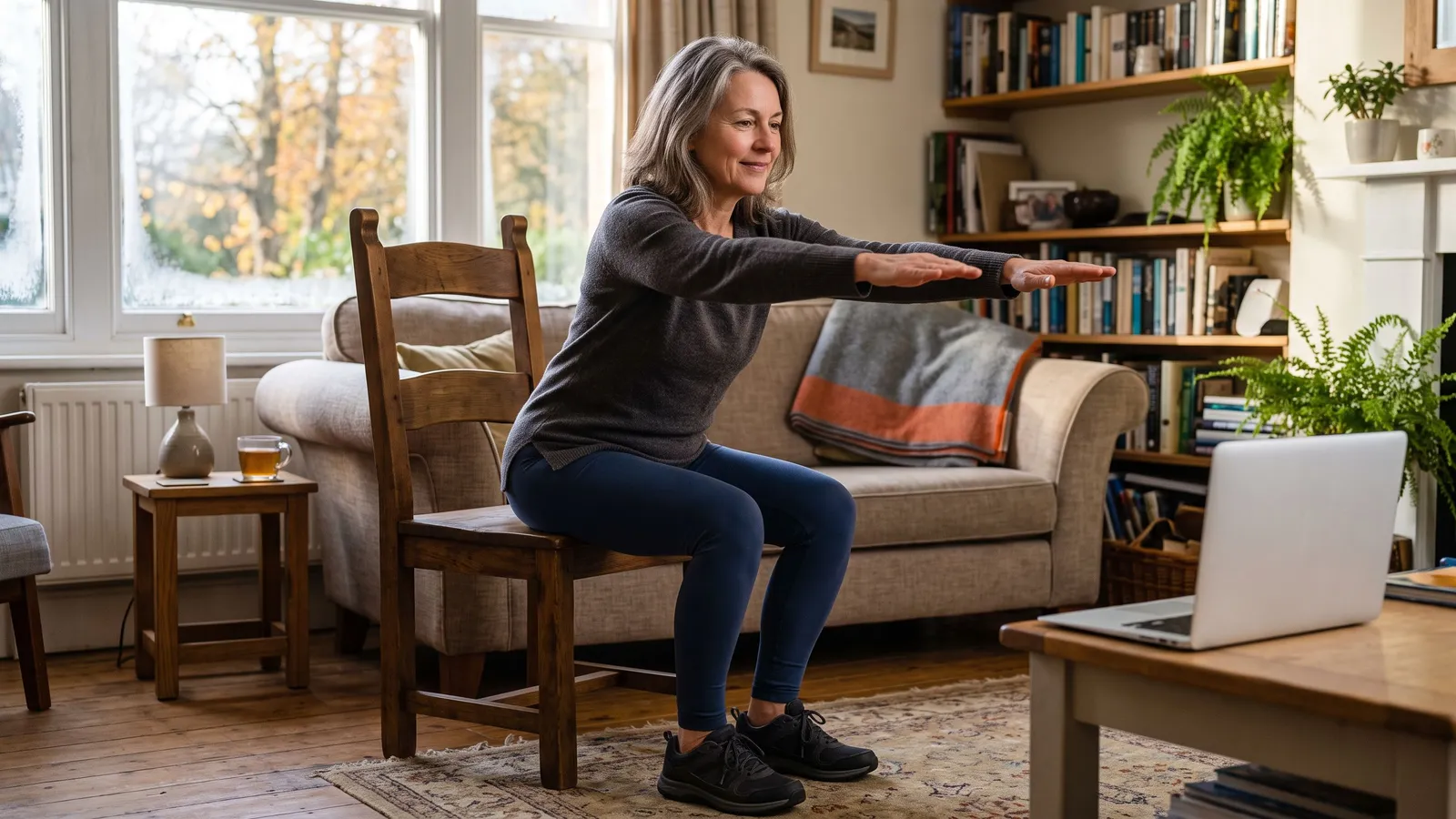
The best exercises for knee pain after 50 are simple strength moves for the thighs, hips and calves, done slowly and within a comfortable range, a few days a week. Research on achy and arthritic knees shows regular exercise reduces pain and helps you move better. Start with the seven moves below, keep the effort moderate, and check with your doctor first if any of the warning signs further down apply to you.
If your knees feel worse on cold November mornings or after a long holiday drive, you are not imagining it. Stiff knees often feel worst after you have been still.
Why exercises for knee pain work
It can feel backwards to move a knee that aches, but the major bodies agree. The 2019 guideline from the American College of Rheumatology and the Arthritis Foundation gave exercise a strong recommendation for people with knee osteoarthritis, along with tai chi and self-management programs.
A Cochrane review pooled 44 trials with 3,537 people who had knee osteoarthritis. It found high-quality evidence that land-based exercise reduced pain, by the equivalent of about 12 points on a 100-point scale, and moderate-quality evidence that it improved physical function. A 2024 update again found exercise may improve pain, though it rated that evidence low certainty. The 2015 reviewers also noted that individually delivered programs tended to show bigger improvements than class-based or home-based ones.
The US Physical Activity Guidelines ask adults with chronic conditions who are able to get at least 150 minutes a week of moderate activity plus muscle strengthening on 2 or more days a week, and otherwise to be as active as their abilities allow. The NIH arthritis institute (NIAMS) notes that women are more likely than men to have osteoarthritis, especially after 50, and suggests strengthening, range of motion, balance and low-impact activity, started slowly.
Next question: Can you strength train safely if you have arthritis?
See a doctor or physical therapist first if
This post is general guidance, not a diagnosis. Get your knee checked before you start, or before you continue, if any of these apply:
- Your knee buckles, gives way or locks so you cannot straighten it.
- The joint is hot, red or very swollen, or you have a fever with knee pain.
- You cannot put weight on the leg, or the pain started after a fall, twist or pop.
- Pain wakes you at night or keeps getting worse week to week.
- You have had knee surgery or a replacement and are not cleared to exercise.
- You have calf pain and swelling, numbness or tingling in that leg.
- You have a heart, lung or other condition you have not discussed with your doctor.
Next question: How does a coach adjust workouts for bad knees?
7 knee-friendly moves to start with
Do these 2 to 3 days a week with a rest day between. The Arthritis Foundation suggests beginners start with one set of 3 to 4 repetitions and build to 8 to 10, then add sets as it gets easier, up to three. Move slowly, breathe out on the effort and stay in a range that feels manageable.
1. Sit-to-stand
Sit near the front of a sturdy chair, feet hip-width apart. Lean slightly forward, press through your whole foot and stand. Lower slowly, about three seconds. Cue: knees point the same way as your second toe. Add a cushion if the chair is too low.
2. Glute bridge
Lie on your back, knees bent, feet flat. Squeeze your seat and lift your hips until your body makes a line from shoulders to knees. Pause, then lower. Cue: push through your heels and keep your knees from falling in or out.
3. Straight-leg raise
Lie on your back with one knee bent and the other leg straight. Tighten the front of the straight thigh, then lift that leg to the height of the bent knee. Lower slowly. It builds the quadriceps without bending the knee, handy on sore days.
4. Side-lying leg raise
Lie on your side, bottom knee bent for balance, top leg straight. Lift the top leg a little above hip height, toes pointing forward, then lower. This works the outer hip muscles that keep the knee from drifting inward on stairs.
5. Step-up to a low step
Use the bottom stair or a low, sturdy step, with a rail for balance. Step up, press through the heel, bring the other foot up, then step down slowly. Cue: the working knee stays over the foot, not caving in.
6. Partial wall sit
Stand with your back against a wall, feet a step out in front. Slide down only a few inches and hold for 10 to 20 seconds, then slide up. Go only as low as feels comfortable.
7. Calf raise
Hold a counter, rise onto the balls of your feet, pause, and lower slowly. It doubles as balance practice.
Next question: What other leg exercises are safe after 60?
Good discomfort or a reason to stop?
Some aching is normal when you start strengthening. Here is a simple way to read it.
Usually fine to keep going:
- Muscle effort or a mild burn in the thighs, hips or calves.
- A mild, familiar knee ache that does not climb as you go.
- Stiffness that eases as you warm up.
- Mild soreness the next day that settles within a day or so.
Stop that move and change it, or call it a day:
- Sharp, stabbing or pinching pain in the joint.
- Pain that builds rep after rep or makes you limp.
- New swelling, or the knee feeling unstable.
- Pain that is clearly worse the day after than it was before you trained.
If a move hurts, the fix is often small: a shorter range, a higher chair or a lower step. If it keeps hurting after changes, drop it and ask your doctor or physical therapist.
Next question: What does a low-impact workout look like on sore days?
What to avoid in the first few weeks
- Deep squats and lunges. Build strength in the middle range first. Depth can come later if it feels good.
- Jumping and running drills. Save impact for later and walk, cycle or swim for your cardio.
- Going heavy too soon. Add reps before you add weight.
- Skipping the warm-up. Five minutes of marching in place or easy cycling makes stiff knees feel better before you load them.
Next question: How do you add weight without hurting your knees?
Cold mornings and holiday travel
- Warm up indoors before a cold walk, even just a few sit-to-stands and calf raises.
- On long drives, stop every hour or two to walk. On a plane, do seated knee straightens and ankle circles.
- Pack your routine. Every move above works in a guest room with a chair and a bed.
- Keep your training days through the holidays. Two short sessions beat none.
Next question: How do you keep training while traveling for the holidays?
Why a coach watching your knees helps
Free apps and AI chatbots can write a decent knee-friendly plan, and they are always available. What they cannot do well is watch your knee drift inward on the third step-up, notice you are favoring one leg, or see that a chair is too low for you today.
Knee-friendly training comes down to small adjustments in the moment: angle, depth, step height, tempo. A live coach on video sees your alignment, changes the move on the spot and remembers that your left knee was cranky last Tuesday, which echoes the Cochrane finding that individually delivered programs tended to do better. And someone expects you at 7:00 on a dark morning.
Next question: Is online training as good as a trainer in person?
How HipTrain can help
HipTrain is live 1-on-1 personal training over video with a real certified coach who watches your form, adjusts each move for your knees and keeps you on track, from $14 per session. Many clients are women over 50. Sessions are HSA/FSA eligible, which is worth knowing if you have FSA money left before year end. Book a free trial session and your coach will start with the moves your knees like.
FAQ
How often should I do exercises for knee pain?
Two to three days a week of strength work is a sensible start, with rest days between. The US guidelines recommend muscle strengthening on 2 or more days a week, plus regular low-impact activity like walking or cycling.
Is walking good for knee pain?
For many people with mild wear or osteoarthritis, yes. Start with shorter, flatter walks and build up. If walking makes your knee swell or hurt more the next day, cut back and get it checked.
Can I do these exercises if I have arthritis?
Most people with mild knee osteoarthritis can, and the ACR and Arthritis Foundation guideline strongly recommends exercise. If you have a diagnosis, recent injury or surgery, confirm with your doctor or physical therapist first.