Fall fitness plan: a realistic 6-week reset
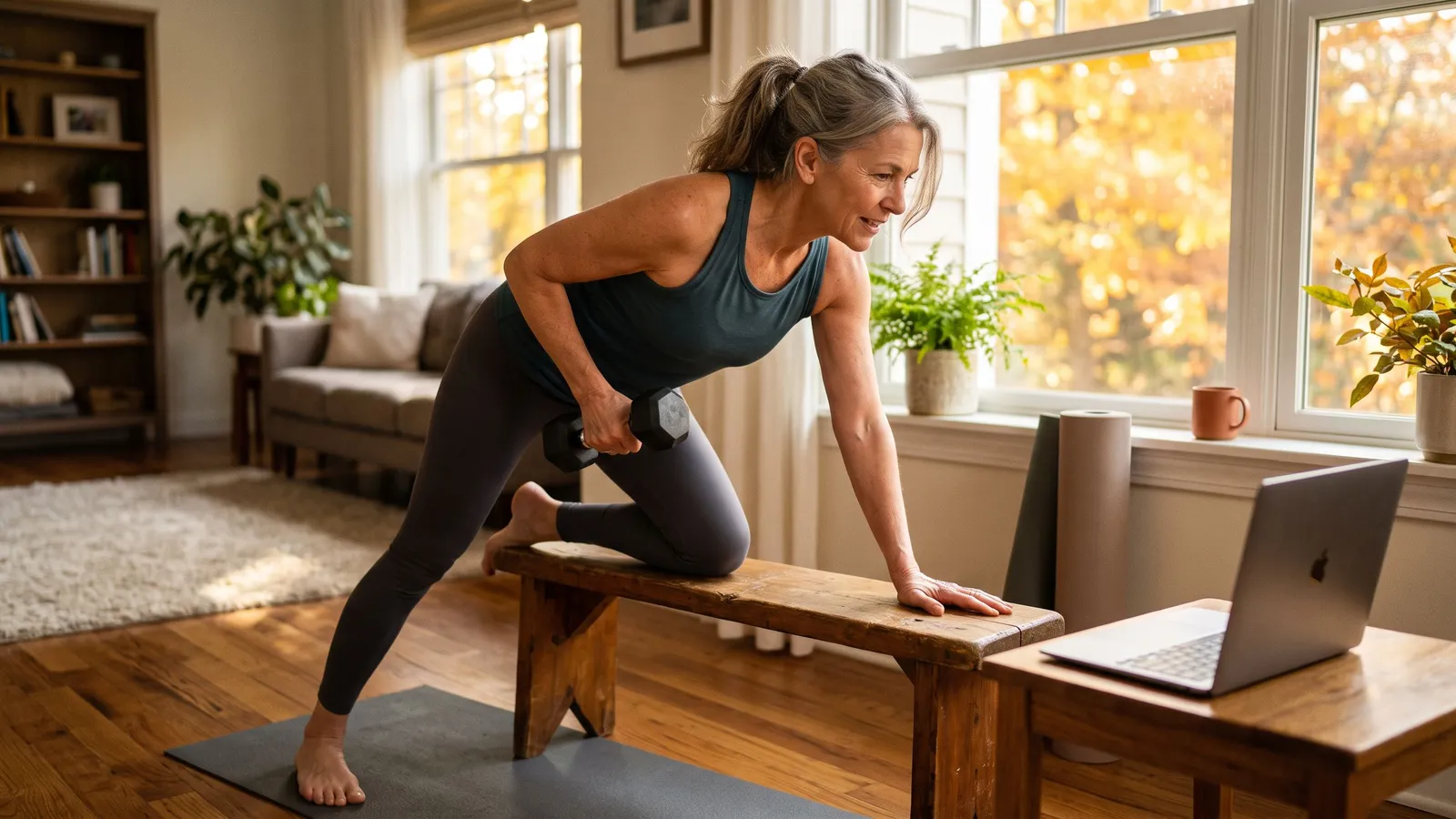
If your routine slipped over the summer, the best fall fitness plan is not a hard one. It is a light one you can repeat: two short strength sessions, two walks or easy cardio sessions, and one mobility day each week, for six weeks, with small increases along the way. Start at about half of what you think you can do, add a little every week, and arrive at the holidays with a routine that is already running instead of a resolution waiting for January.
It is written for the person we train most often over video: a woman in her 50s who used to be active, lost the thread between July and September, and wants to feel strong again before Thanksgiving. One note first: if you have a heart condition, a recent injury or any other medical condition, talk to your doctor before starting a new program.
The weekly structure of this fall fitness plan
Every week has the same five slots. Put them on the calendar the way you would a meeting.
- Two strength days (Monday and Thursday). Twenty-five to 35 minutes, five or six whole-body movements: a squat or sit-to-stand, a hip hinge such as a glute bridge, a push such as an incline push-up, a pull such as a band row, a carry, and one core move such as a side plank.
- Two walks or cardio days (Tuesday and Saturday). Twenty to 40 minutes at a pace where you can talk but would rather not sing. A brisk walk counts.
- One mobility day (Sunday). Fifteen to 20 minutes of hip, ankle, shoulder and spine work. It is the day most people skip and the one that makes the other four feel better.
The two rest days are part of the plan. By week four the structure lines up with the CDC guideline for adults: 150 minutes of moderate-intensity activity a week plus at least two days of muscle-strengthening activity. Week one will not get there, and that is on purpose.
Start lighter than you think
The most common mistake after a layoff is picking up where you left off in May. Your lungs remember; your tendons do not. For the first two weeks, choose a weight you could lift about 15 times and stop at eight to ten, at an effort of five or six out of ten. Finish every session feeling like you could have done more, because next week you will.
Mild soreness the next day is normal. If you cannot sit down without wincing two days later, cut the next session in half. Nobody has ever regretted an easy first week; plenty of people have quit after a brutal one.
Harvard Health notes that after age 30 you begin to lose as much as 3% to 5% of muscle mass per decade, and that progressive resistance training two or three times a week is how you rebuild it. As the exercise physiologist they quote puts it, it is never too late to rebuild muscle and maintain it. That is why the two strength days are the ones to protect.
How to progress over the six weeks
- Weeks 1 and 2: learn the movements. Two sets of eight to ten repetitions of each strength move, light. Twenty-minute walks. Fifteen minutes of mobility. The goal is five sessions a week, not five impressive ones.
- Weeks 3 and 4: add a little. A third set, two more repetitions, or the next weight up, on two of the six movements, not all. Stretch the walks to 30 minutes and add four one-minute brisk intervals to one.
- Weeks 5 and 6: measure something. Take the last set to a seven or eight out of ten. Pick one test and compare it with week one: sit-to-stands in 30 seconds, a plank hold, or the weight on your row. Walks of 30 to 40 minutes.
Change one variable at a time. If a week goes sideways because of travel or a cold, repeat it instead of skipping ahead. If you are starting from nothing, our page for beginners covers the first-session questions this post skips.
When dark evenings kill your motivation
Clocks go back on the first Sunday of November and, for a lot of people, that is when the plan dies. It is dark at 5:30 and the couch is warm. A few things that work for the people we coach:
- Move the session to morning or lunch. Lay out your clothes the night before and get it done before the day runs over it.
- Make it an appointment with a person. "I will work out tonight" is a wish. "My coach is on the call at 7:00" is a plan. Book a specific time with a specific person: a coach, a neighbor, a friend on FaceTime.
- Shrink it before you skip it. Keep a ten-minute version of every workout: one set of each movement, or a walk around the block. The habit is what you are building this fall.
- Track sessions done, not pounds. A paper calendar on the fridge with an X for each completed slot tells you more than the scale will. On a tired day, do the mobility session instead and mark the X anyway.
Apps, chatbots and a coach who can actually see you
You can get a plan a lot like this one from a chatbot in thirty seconds, and the plan it writes is usually sensible. Pew Research Center found that 34% of U.S. adults had used ChatGPT by early 2025, including one in four adults aged 50 to 64. Apps are the same story: in the ACSM Worldwide Fitness Trends for 2027, wearable technology ranked first and mobile exercise apps second, with fitness programs for older adults fourth and traditional strength training fifth.
Apps and chatbots are cheap, awake at 5 a.m., and their programming is decent. What none of them can do is watch you.
A coach who sees you over live video notices your knees drifting inward on a squat and fixes it on that repetition. Your coach sees you wince on a lunge and swaps the movement, remembers that your shoulder was cranky last Thursday, and cuts the volume on the night you show up tired. And the simplest difference of all: a person is expecting you at 7:00. A notification can be swiped away; a coach who said "see you Thursday" cannot.
HipTrain itself runs on technology, the video call, the app and the scheduling, so this is not a case against tech. It is a case for a human on the other end of it. Our guide to the best online personal training services covers where apps, group programs and live coaching each fit.
A note on FSA money before year end
If you have a health flexible spending account, check the balance now. HealthCare.gov explains that FSA money generally must be used within the plan year; some employers offer a grace period of up to two and a half months or a limited carryover, but they are not required to, and anything left is forfeited. HipTrain sessions are HSA and FSA eligible; the details, including what paperwork your plan may ask for, are on our HSA and FSA page.
How HipTrain helps
HipTrain is live 1-on-1 personal training over video with a certified coach who sees you, builds this plan around your equipment, your schedule and your knees, and adjusts it week by week. Most of our clients are women in their 40s to 60s training at home, and the service is rated 5.0 on Google. Training is from $14 per session, and your first session is free with no card required. Book your free trial session and we will set up week one together.
FAQ
What equipment do I need for this fall fitness plan?
A pair of dumbbells or a long resistance band, a sturdy chair and a mat. Every movement in weeks one and two has a bodyweight version, so you can start with nothing.
I have not exercised in years. Is six weeks too ambitious?
No. The first two weeks are deliberately easy, and the plan is built to be repeated rather than survived. If you have a medical condition, check with your doctor, then start with the walks and mobility and add strength when you feel ready.
If I only have time for strength or cardio, which should I keep?
Keep the two strength days. Muscle is what slips with age, and it is what makes stairs, groceries and getting off the floor feel easy. Walk on the other days whenever you can.
Can I follow this plan at a gym or with an in-person trainer instead?
Yes, the structure is the same anywhere. The real questions are cost, travel time and whether someone is checking your form. Our comparison of in-person versus live video training lays out the trade-offs.